
Loading page…
Solutions
A withdrawal and spendable income are two different numbers, and taxes sit in the gap between them. This page explains how a tax-advantaged retirement plan works in plain English, and we never treat the phrase “tax-free” as a guarantee.
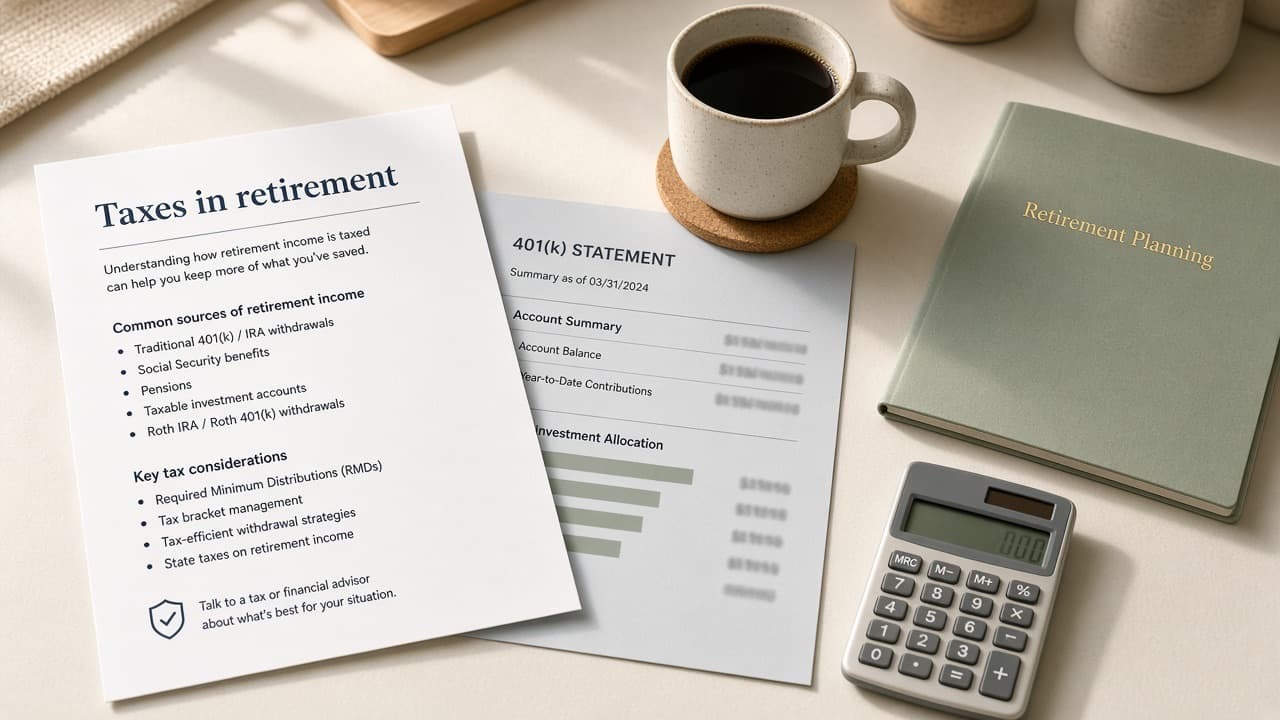
We begin with the accounts you already have, when you might use each one, and how a tax advantaged retirement savings plan at work (a 401(k), for instance) sits next to a Roth IRA or a regular brokerage account. Some people also hear insurance-based designs described as a complement to workplace plans. They’re a complement at best, never a replacement, and we’ll show you where they fall short. Honestly, retirement tax planning is mostly about order and timing, and much less about finding a clever trick. Our short read on how taxes may affect retirement is a good warm-up if you’d like the basics first.
Tax-efficient retirement planning usually asks which dollars to spend first. Pre-tax money (traditional 401(k), traditional IRA) gets taxed as ordinary income when it comes out. Roth money, if the rules are met, may come out tax-free. A taxable brokerage account sits somewhere in between, with capital gains rules of its own. Draw from the wrong bucket in the wrong year and you can push yourself into a higher bracket for no good reason. Texas has no state income tax, which helps if you live in Arlington, but it does nothing for the federal side. Move to another state later and the picture changes.
If you want to calculate taxes on 401k withdrawal amounts yourself, here’s the rough method:
Watch out for withholding. A lump sum from an employer plan can have 20% withheld up front, and that may be more or less than you’ll truly owe. A tax pro can run the real numbers, and our retirement calculator can give you a quick, taxless sketch to start from.
A roth conversion in retirement means moving pre-tax money into a Roth and paying the tax on it now, hoping for lower taxes later. The years between when you stop working and when required distributions begin are often the best window, since your income may be lower. The catches are real, though. The converted amount counts as income that year, it can bump you into a higher bracket, and it can even raise your Medicare premiums two years down the road. Bring your CPA into this one.
To manage your tax bracket in retirement, people usually try to fill the lower brackets on purpose, taking just enough income each year to stay below the next step up. Social Security adds a wrinkle, because up to 85% of your benefit can end up counted as taxable income once your other income crosses certain thresholds. That’s why the same $10,000 withdrawal can cost you very different amounts in two different years. For how this connects to your paycheck, see retirement income planning.
We will not promise tax-free withdrawals, and we won’t tell you a product is the answer from a webpage. Tax treatment depends on the law as it stands and on your facts, and both change. Bring your CPA into any decision that affects a return. We’re happy to join that conversation and explain the insurance mechanics so everyone is working from the same page.
Educational information only. Suitability depends on your circumstances. Nothing here is a recommendation to buy or replace a product.
Questions
Book a free conversation and bring your questions about taxes in retirement. Educational information only. Suitability depends on your circumstances. Nothing here is a recommendation to buy or replace a product.